

When “Being a Team Player” Means Working for Free
Disclaimer: This article is for informational purposes only and does not constitute legal advice. If you have specific legal concerns regarding labor laws, consult a qualified attorney or the U.S. Department of Labor for guidance.
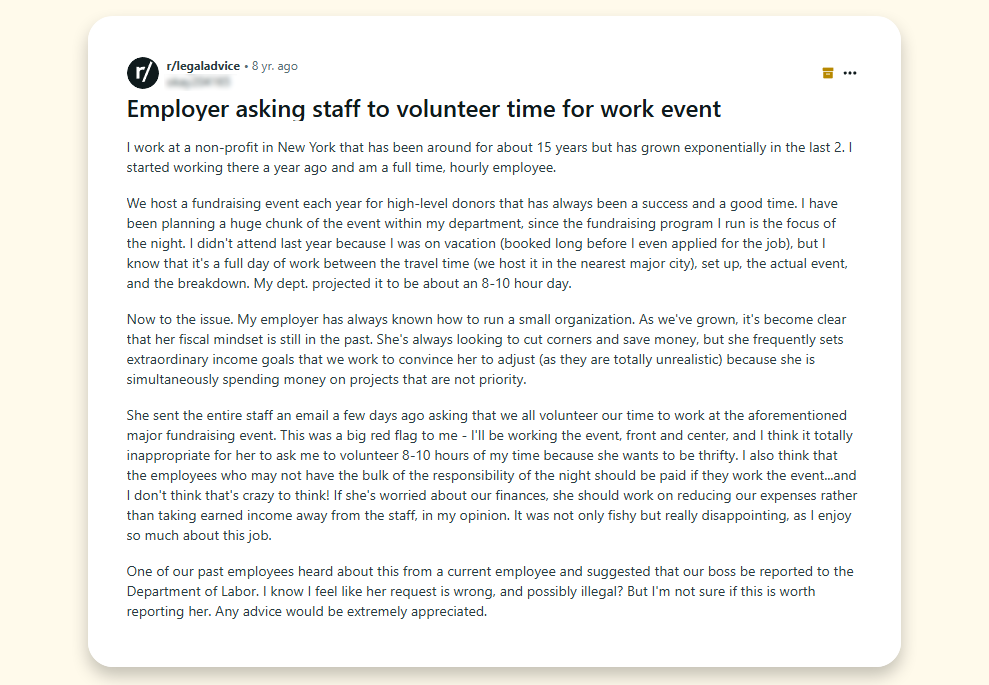
The screenshot above, posted on Reddit in r/legaladvice, captures a dilemma familiar to many nonprofit workers: an employer asking staff to “volunteer” their time for a major fundraising event. The poster, an hourly employee at a growing New York nonprofit, expresses disappointment and concern over being asked to work an 8-10 hour event without pay, questioning the legality and ethics of the request.
This isn’t an isolated incident. A warm evening in spring, just weeks before your nonprofit’s annual gala. The conference room table is strewn with seating charts and volunteer schedules, your development director staring at staffing gaps with growing anxiety. Then comes the suggestion, offered almost casually: “Why don’t we just ask our program staff to help out? They’re already invested in our mission.”
It’s a scene that plays out in nonprofits across the country. The logic seems sound—these are employees who’ve dedicated their careers to your cause. Surely they’d be happy to donate a few evening hours for your biggest fundraiser?
But beneath this seemingly benign request lies a darker reality. Your program coordinator smiles and says “of course” while mentally rearranging childcare. Your outreach specialist, living paycheck to paycheck, swallows his concerns about unpaid hours to remain a “team player.” Your case managers, already exhausted from carrying their clients’ traumas, nod while wondering when they’ll find time to recover.
The cruel irony? Many of these organizations exist to fight exploitation and advocate for workers’ rights—yet they’ve normalized taking advantage of their own employees’ dedication. We’ve created a culture where passion for the mission is weaponized against the very people who carry it out.
As sector leaders, we’ve convinced ourselves this is just how things work in the nonprofit world—that tight budgets and passionate staff somehow make it acceptable to blur the lines between employment and volunteerism.
But here’s the deal: this practice is not only unethical—it’s illegal.
The Legal Reality
Nonprofits Are Not Exempt From Misconduct
Nonprofits often assume they are exempt from certain labor laws due to their charitable nature, but this is a dangerous and costly misconception. The Fair Labor Standards Act (FLSA) (U.S. Department of Labor, 2023) applies to nonprofit organizations just as it does to for-profit businesses when employees are engaged in work that supports the organization’s commercial activities or generates revenue.
Under the FLSA, employees cannot legally volunteer their time for their own employer in the same or similar capacity as their paid role. The Department of Labor (DOL) strictly enforces this rule, and violations can lead to back wages, fines, and legal action (DOL Fact Sheet #14A, 2022).
Key Legal Considerations for Nonprofits
How Nonprofits Violate These Laws (Even Unintentionally)
Legal Consequences of FLSA Violations
A well-known case involved a nonprofit event planning organization that relied on unpaid staff labor at its annual gala. After multiple complaints, the DOL ruled that these staff members were entitled to back pay, resulting in thousands of dollars in fines and settlements (Williams Parker, 2018).
Nonprofits should not assume that being mission-driven exempts them from labor laws. If the work benefits the organization, it must be compensated.
Under the Fair Labor Standards Act (FLSA) (U.S. Department of Labor, 2023), employees of nonprofit organizations cannot legally volunteer their time to perform the same or similar duties they are paid to do. The Department of Labor (DOL) has clear rules about what constitutes legitimate volunteering versus wage violations (DOL Fact Sheet #14A, 2022).
- Employees must be paid for time spent doing work that benefits their employer (FLSA, 29 U.S.C. § 203(e)).
- A nonprofit employee cannot volunteer for their own organization in a similar capacity to their paid work (DOL, 2022).
- Nonprofits must track and compensate employees for all hours worked, including overtime (DOL Wage and Hour Division, 2023).
Failure to comply with these regulations can result in wage theft claims, DOL investigations, fines, and lawsuits (Williams Parker, 2018).
if you are a lawless rebel
Consider The Ethical Implications
Beyond legality, there’s a major ethical issue at play. Nonprofit staff are already underpaid compared to for-profit counterparts (Nonprofit Quarterly, 2023), and many work long hours out of passion for the mission. Asking them to donate additional time is exploitative and fosters a toxic work culture (Council of Nonprofits, 2023).
The Power Dynamics at Play

Fear of Retaliation and Job Security
Employees may feel pressured to “volunteer” due to fear of retaliation or looking disloyal. If an employee declines to help at an event, they may worry about being viewed as less dedicated to the mission, which can impact promotions, job security, or workplace relationships.

Guilt-Tripping as a Management Tool
Leadership may guilt staff by equating unpaid labor with commitment to the cause. Statements like “We’re all in this together” or “If you really care about the mission, you’ll pitch in” manipulate employees into working for free, despite financial strain or burnout.

The Board’s Disconnect from Paid Staff
Board members and executives (who are often unpaid volunteers themselves) may fail to recognize the difference between their voluntary service and the necessity of paying employees for their labor. This results in a mindset where staff are expected to operate on the same volunteer basis, ignoring the reality that their income depends on fair compensation.
This pressure can lead to burnout, resentment, and high turnover, ultimately hurting the nonprofit’s mission (Nonprofit Financial Mastery, 2023).
“all hands on deck”
Dismantling a Harmful Nonprofit Tradition
The rallying cry of “all hands on deck” has become a euphemism for unpaid labor in the nonprofit sector. While it sounds collaborative and mission-driven, this culture often masks systematic wage theft and staff exploitation. Understanding how this mindset develops is the first step toward meaningful change.
Understanding the Cycle
The cycle begins during event planning, where budgets focus intensely on donor experience and fundraising goals while treating staff time as a free, unlimited resource. Planning committees, often composed of board members and development staff, rarely include the front-line workers who will shoulder much of the burden. Labor costs are minimized or ignored entirely in these early stages, setting up an unsustainable execution model.
During implementation, staff members receive carefully worded “invitations” to volunteer their time. These requests carry the weight of professional obligation, building pressure through peer expectations. Those who question the practice find themselves labeled as uncommitted to the mission. Meanwhile, regular duties pile up as event work increases, creating a double burden of responsibility.
The aftermath brings predictable results: increased staff burnout, rising resentment, and eventually, higher turnover. Yet rather than examining the root causes, many organizations simply restart the cycle with their next event, treating staff departures as unfortunate but unrelated circumstances.
Confronting Common Rationalizations
When nonprofit leaders defend this practice, they often invoke the mission as justification. “It’s for the cause,” they explain, as if exploitation becomes acceptable when done in service of good works. The reality is that undermining staff wellbeing directly contradicts most nonprofits’ stated values and ultimately weakens their impact.
Organizations frequently claim poverty as a defense: “We’re a nonprofit, we can’t afford extra wages.” This argument ignores basic business principles. If an event budget cannot include fair staff compensation, the event itself requires restructuring. This might mean scaling down, increasing ticket prices, finding additional sponsors, or in some cases, cancellation. Running events on the backs of unpaid staff labor isn’t just ethically wrong – it’s financially unsustainable.
The claim that “everyone’s pitching in” obscures crucial distinctions between stakeholders. Board members serve in a governance capacity and often bring significant resources to the table. Volunteers choose to donate their time freely. Staff members are professionals who depend on their salaries for survival. Conflating these roles doesn’t create unity – it creates confusion and resentment.
Breaking the Cycle
Real change begins with board education. Many board members simply don’t understand labor laws or recognize their liability exposure. They need clear information about the true costs of staff time, the risks of labor law violations, and alternative event models that don’t rely on exploitation.
Budget transparency forms another crucial element. Organizations must account for all labor costs, including overtime, preparation time, and the impact on regular operations. This often reveals that “successful” events are actually running at a loss when all costs are properly calculated.
The deeper work involves a fundamental cultural shift. Organizations must eliminate the practice of asking staff to “volunteer,” create clear role distinctions, and celebrate professional boundaries. Staff expertise should be valued and compensated appropriately, not treated as an endless resource to be tapped at will.
Moving Forward
The “all hands on deck” culture represents more than just event management problems – it reveals deeper issues in nonprofit management. Creating truly healthy organizations requires respecting professional boundaries, recognizing staff expertise, implementing fair compensation practices, and developing sustainable operational models.
By dismantling this culture, nonprofits can build stronger organizations that truly reflect their values and achieve their missions without exploiting their most valuable resource: their staff. This transformation won’t happen overnight, but it begins with naming the problem and committing to change.
The Broader Impact
Understanding and Addressing Systemic Issues
When nonprofits normalize unpaid labor, it often reveals deeper organizational issues. Beyond the immediate ethical concerns of uncompensated work, these organizations frequently engage in other problematic practices: widespread unpaid overtime, worker misclassification, pressure on staff to donate portions of their salaries back to the organization, and a culture that glorifies overwork as dedication to the cause.
These practices create a toxic cycle. Staff face mounting pressure to prove their commitment through personal sacrifice, while organizations avoid addressing fundamental issues with staffing, budgeting, and sustainable operations. The resulting environment leads to burnout, high turnover, and diminished program effectiveness – ultimately undermining the very mission these sacrifices allegedly serve.
Breaking this cycle requires decisive action from leadership. Boards must prioritize proper labor budgeting and ensure compliance with employment laws. Organizations should invest in temporary staff or contractors for events rather than exploiting existing employees. Most importantly, nonprofits need to shift toward sustainable fundraising models that don’t rely on unpaid labor, such as monthly giving programs or earned income streams.
While this transformation requires initial investment, the cost of maintaining exploitative practices – including legal liability, staff turnover, and reputational damage – far exceeds the resources needed to create ethical, sustainable operations. Organizations that make this shift often emerge stronger and better equipped to create lasting social impact.
Finding the Right Balance
The Value and Limits of Volunteer Work
Volunteerism is a cornerstone of the nonprofit sector. From board members donating their expertise to community members staffing food banks, genuine volunteers create immense social value and strengthen organizational missions. This spirit of giving time freely is something to celebrate and nurture.
However, there’s a crucial distinction between true volunteers and employees being pressured to work without pay. When organizations expect paid staff to “volunteer” at galas, fundraisers, or weekend events, they cross both ethical and legal lines. The Department of Labor is clear: employees cannot “volunteer” services that are similar to their paid work for the same organization.
The solution isn’t to abandon events or volunteer engagement – it’s to respect the boundaries between paid staff and genuine volunteers. Organizations should:
- Welcome and appreciate true volunteers who choose to give their time
- Budget properly for event staffing and overtime when needed
- Hire temporary staff or contractors for special events
- Ensure clear policies distinguishing volunteer roles from paid position
Your dedicated staff chose nonprofit work because they believe in the mission. Honor that commitment by treating them as the professionals they are, not an unpaid labor pool. A sustainable organization respects both the spirit of volunteerism and the rights of its employees.
Keep in Mind:
Nonprofit staff are not volunteers.
Employees have a legal right to fair compensation for their work. Asking them to “volunteer” their time for organizational events is both unethical and, in many cases, illegal.